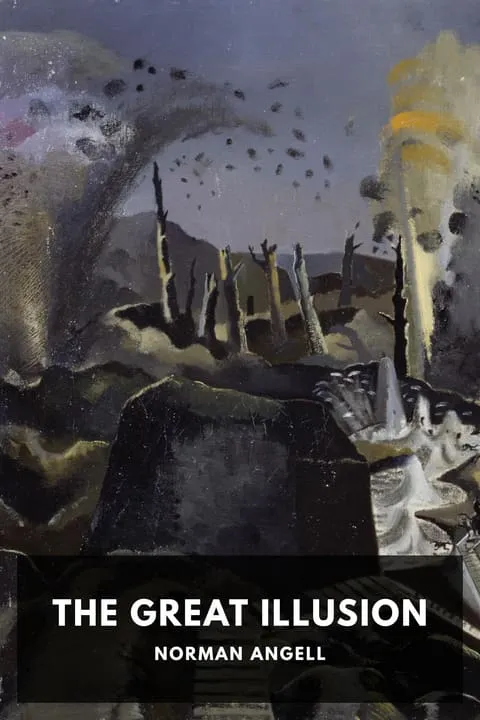
The Great Illusion
A philosopher and M.P. argues that the financial and commercial interdependence of modern nations renders military conquest economically futile and traditional empire-building self-defeating.
Contents
- Imprint
- Preface to the Fourth American Edition
- Preface
- Synopsis
- Part I: The Economics of the Case
- I: Statement of the Economic Case for War
- II: The Axioms of Modern Statecraft
- III: The Great Illusion
- IV: The Impossibility of Confiscation
- V: Foreign Trade and Military Power
- VI: The Indemnity Futility
- VII: How Colonies Are Owned
Show all 29 chapters
- VIII: The Fight for “The Place in the Sun”
- Part II: The Human Nature and Morals of the Case
- I: The Psychological Case for War
- II: The Psychological Case for Peace
- III: Unchanging Human Nature
- IV: Do the Warlike Nations Inherit the Earth?
- V: The Diminishing Factor of Physical Force: Psychological Results
- VI: The State as a Person: A False Analogy and Its Consequences
- Part III: The Practical Outcome
- I: The Relation of Defence to Aggression
- II: Armament, but Not Alone Armament
- III: Is the Political Reformation Possible?
- IV: Methods
- Appendix
- Endnotes
- Colophon
- Uncopyright
Listen free in LeziBook
Get LeziBook, open the Store, find “The Great Illusion” and tap Listen now. The book lands in your library and the app starts reading aloud.
Source: Standard Ebooks. CC0 1.0 (Standard Ebooks edition); the text is in the public domain
 Việc làng
 Việt Nam Sử Lược
 “We”
 A General History of the Pirates
 A Journal of the Plague Year
 A Negro Explorer at the North Pole